

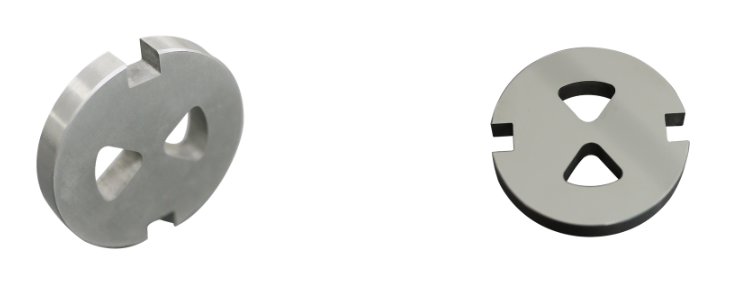
PDC Throttle Plates: Redefining Durability and Precision in Extreme Conditions
At the heart of PDC throttle plates lies the unique polycrystalline diamond compact material. This composite combines the extreme hardness and wear resistance of diamond with the toughness of a tungsten carbide substrate, making it ideal for handling abrasive media such as sand-laden or multiphase flows. Compared to traditional hard alloy or ceramic-coated throttling devices, PDC throttle plates can last five times longer or more in extreme wear environments, significantly reducing replacement frequency and maintenance costs.
Key Challenges in Oil & Gas Flow Control and the PDC Solution
Throttle valves and plates regulate fluid pressure and flow in oil and gas production, directly impacting system efficiency and safety. Common challenges include:
1. High-velocity fluid erosion-especially from sand-laden gas or liquids, which rapidly wear down traditional materials.
2. Cavitation damage-micro-jetting caused by bubble collapse during sudden pressure changes erodes surfaces.
3. Corrosive environments-acidic media (e.g., H₂S or CO₂-containing fluids) chemically degrade materials.
PDC throttle plates address these challenges through:
lExceptional wear resistance-PDC is second only to natural diamond in hardness, offering superior resistance to solid particle erosion.
lCavitation resistance-Dense structure and high strength minimize micro-cracking and pitting from cavitation.
lChemical stability-Diamond-based materials exhibit excellent resistance to most acidic environments.
lGeometric integrity retention-Maintain precise flow passage shapes over time, ensuring consistent flow control accuracy.
Technical Advantages: Why PDC Throttle Plates Are a Smart Investment
Extended Maintenance Cycles and Lower Total Cost of Ownership
Although the initial investment for PDC throttle plates may be higher than traditional options, their extended replacement intervals (from months to years) significantly reduce downtime, labor costs, and spare parts inventory. In the long term, the total cost of ownership (TCO) decreases substantially.
Improved Flow Control Stability and Accuracy
Wear-induced changes in throttle orifice geometry directly affect the flow coefficient (Cv), compromising control precision. PDC’s ability to retain its shape ensures more durable and predictable flow characteristics, supporting stable process control in oil and gas applications.
Adaptability to a Wider Range of Operating Conditions
PDC throttle plates are suitable for various scenarios, from routine production to extreme conditions (e.g., high-pressure differentials, high flow rates, solid-laden fluids), including:
lWellhead throttling
lProduction separator inlet control
lWater injection systems
lHigh-pressure differential letdown stations
Implementing PDC Upgrades: Key Considerations
When considering an upgrade to PDC throttle plates, evaluate the following:
1. Operational analysis-Assess fluid composition, pressure/temperature ranges, solid content, etc.
2. Compatibility checks-Ensure compatibility with existing valve bodies, actuators, and control systems.
3. Supplier selection-Choose vendors with proven experience and reliable case studies in the oil and gas industry.
4. Cost-benefit analysis-Calculate ROI based on expected service life and maintenance savings.
Industry Trends: Integrating PDC Technology with Smart Systems
As the concept of the digital oilfield evolves, PDC throttle plates are being combined with intelligent monitoring systems. Sensors can track wear conditions and performance in real time, enabling predictive maintenance. This integration further optimizes maintenance schedules, maximizing equipment uptime and safety.
Conclusion: A Forward-Looking Solution for Flow Control
As the oil and gas industry faces increasingly demanding operating environments and economic pressures, PDC throttle plates represent a significant advancement in flow control technology. They not only address the long-standing challenge of extreme wear but also offer practical solutions for improving system reliability, reducing operational costs, and enhancing safety.
For operators struggling with frequent throttle replacements, declining control accuracy, or planning to upgrade existing facilities, investing in PDC technology is more than just an equipment upgrade—it’s a strategic investment in operational efficiency and long-term competitiveness. With ongoing advances in materials science and manufacturing, PDC throttle plates are poised to play a key role in a wider range of industrial applications, redefining expectations for durability and precision in harsh operating conditions.