


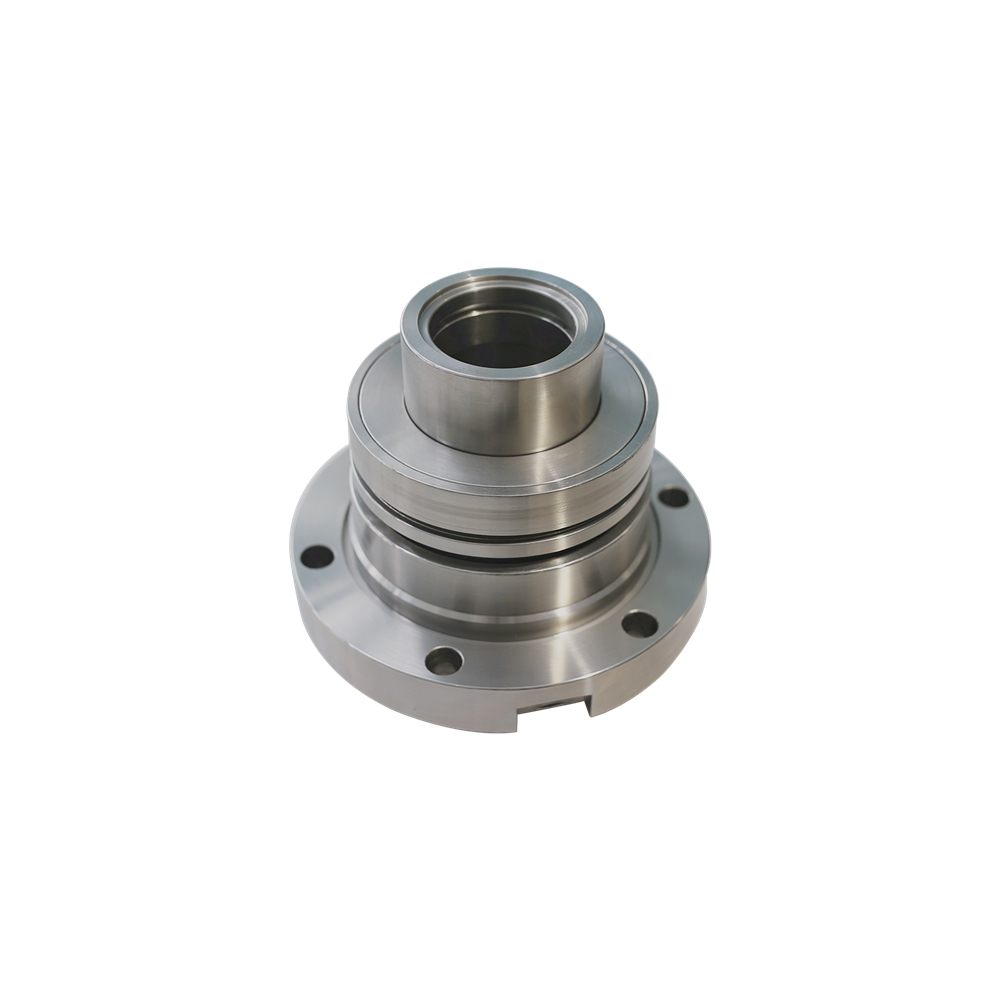
Overview of Mechanical Seals for Pumps:
Since most pumps are used to transport fluid media and have characteristics such as horizontal installation, high rotational speed, high pressure, with solid particles, and strong corrosiveness, the main materials of mechanical seals for pumps often need to withstand the impacts of solid particles' scouring, high-temperature abrasion of the sealing surface caused by high rotational speed, instability of sealing parameters brought about by high pressure, and corrosion of the base structural components. Therefore, higher requirements are imposed on the sealing materials of mechanical seals. Usually, the optional materials for the friction pairs of the sealing surface include nickel-based hard alloys, cobalt-based hard alloys, pressureless sintered silicon carbide, reaction sintered silicon carbide, metal-impregnated graphite, polytetrafluoroethylene-filled graphite, polytetrafluoroethylene-filled glass fiber, special aluminum oxide ceramics, etc.; the base materials can be selected from 2Cr13 stainless iron, 301 stainless steel, 304 stainless steel, 316 stainless steel, 316L stainless steel, 904L stainless steel, polytetrafluoroethylene, etc. Different from mechanical seals for reactors, the sealing media of mechanical seals for pumps are mostly liquids, solid-liquid mixtures, and normal-pressure gases, etc.; while mechanical seals for reactors are mostly used to seal high-pressure gases or gas-liquid mixtures, and leakage will cause serious threats to the environment and living organisms.
Mechanical seals for pumps belong to one of the precise and structurally relatively complex mechanical basic elements and are the key components of pump machinery. Their sealing performance and service life depend on many factors, such as type selection, the precision of the machine, correct installation and use, etc. There are various types and different models of mechanical seals for pumps, and their maintenance is also difficult to identify and judge.
Maintenance of Mechanical Seals for Pumps
There are mainly five leakage points of mechanical seals for pumps:
(1) The seal between the shaft sleeve and the shaft; here, Single Mechanical Seals are often used to ensure a good sealing effect.
(2) The seal between the rotating ring and the shaft sleeve; sometimes, Double Mechanical Seals can be applied to enhance the sealing performance.
(3) The seal between the rotating ring and the stationary ring; in some cases, Cartridge Mechanical Seals may be considered to improve the sealing reliability.
(4) The seal between the stationary ring and the stationary ring seat.
(5) The seal between the sealing end cover and the pump body.
Leakage cause analysis and judgment:
1.Sudden leakage during normal operation. The sudden leakage of centrifugal pump in operation is mostly due to normal wear or has reached the service life, and most of it is caused by large changes in working conditions or improper operation and maintenance.
2.Leakage during test run. After the static test of the mechanical seal with the pump, the centrifugal force generated by high-speed rotation during operation will inhibit the leakage of the medium.
3.One Leakage during static test of installation. After the installation and debugging of the mechanical seal, it is generally necessary to carry out a static test to observe the leakage. If the leakage amount is small, most of the problems exist in the dynamic ring or static ring seal ring; When the leakage is large, it indicates that there is a problem between the dynamic and static ring friction pairs.
2.Leakage during test run. After the static test of the mechanical seal with the pump, the centrifugal force generated by high-speed rotation during operation will inhibit the leakage of the medium.
3.One Leakage during static test of installation. After the installation and debugging of the mechanical seal, it is generally necessary to carry out a static test to observe the leakage. If the leakage amount is small, most of the problems exist in the dynamic ring or static ring seal ring; When the leakage is large, it indicates that there is a problem between the dynamic and static ring friction pairs.
This article hopes to be useful for you to understand pump seals!